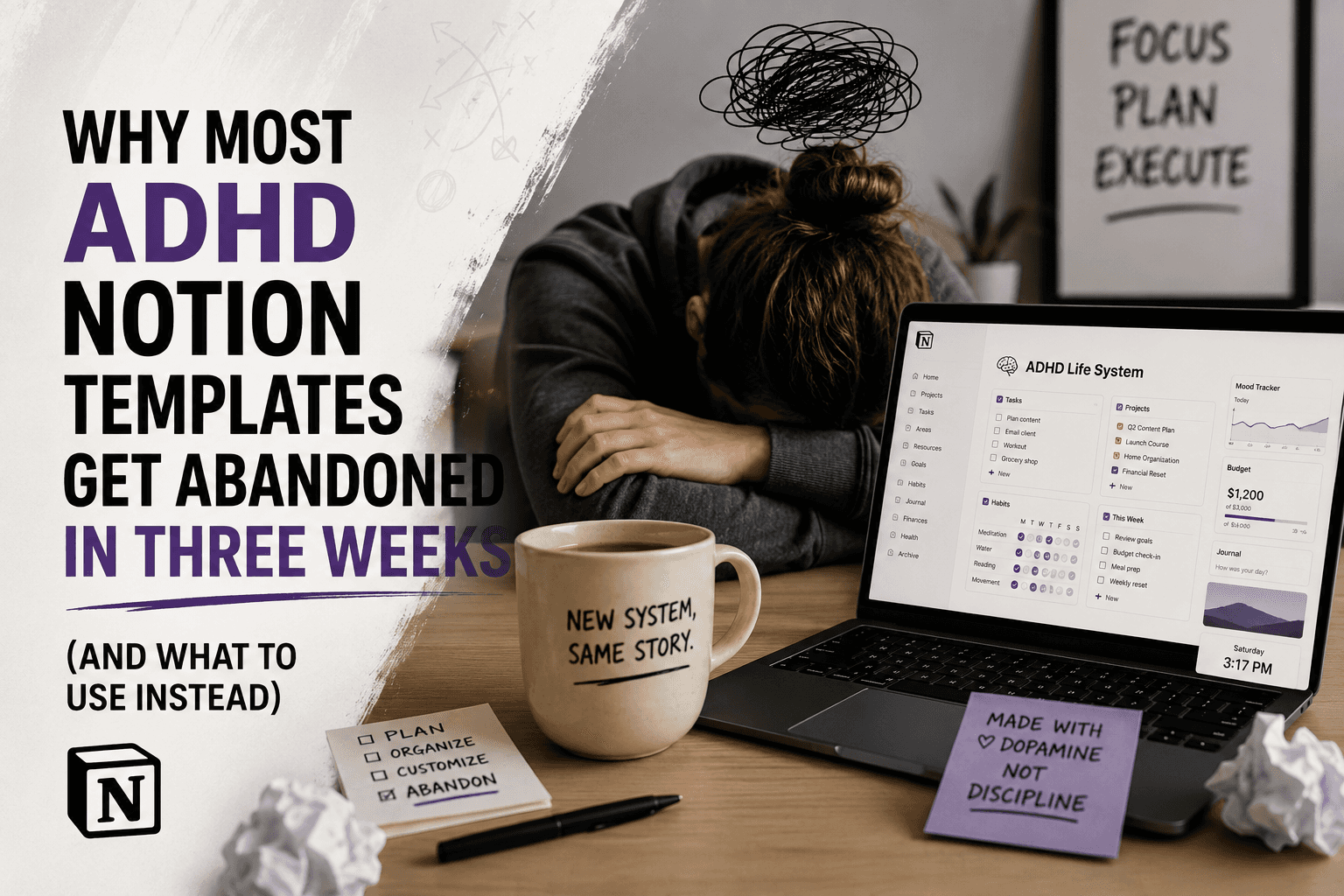
Why Most ADHD Notion Templates Get Abandoned in Three Weeks (And What to Use Instead)
There's a specific Saturday afternoon that anyone with ADHD who's ever flirted with Notion will recognize. You found a template on TikTok or in someone's affiliate-laden roundup post. You bought it for $19, or maybe you cobbled together a free one. You spent four hours customizing color palettes, renaming database properties, building a relations diagram between "Projects" and "Areas" and "Resources" and "Archives" because the PARA method is going to fix everything this time. By 9 PM you have built something that looks, genuinely, beautiful. You take a screenshot. You feel an enormous sense of accomplishment.
You do not open it again after Wednesday.
If this has happened to you more than once — and it has happened to most ADHD adults who try Notion — you are not lazy, undisciplined, or "doing it wrong." You are encountering a predictable failure mode that has been documented in productivity research, behavioral economics, and the lived experience of nearly every ADHD coach working today. The Notion template did not fail because you abandoned it. You abandoned it because the system was designed in a way that almost guaranteed you would.
This article is going to make a case that's mildly heretical in the productivity-influencer ecosystem: most ADHD Notion templates are not productivity tools. They are a more sophisticated, more socially acceptable form of procrastination — one that produces dopamine, screenshots, and the feeling of progress without producing any actual work. And the more elaborate the template, the more reliably this happens.
Let's get into why.
The dopamine economy of "system-building"
To understand why ADHD brains get so reliably trapped in the template-customization loop, you have to understand what's actually happening neurochemically when you customize a system instead of using it.
ADHD is fundamentally a disorder of the dopaminergic system. The classic Volkow et al. work using PET imaging found that adults with ADHD show measurably reduced dopamine transporter and receptor availability in the striatum and midbrain — the parts of the brain responsible for reward processing and motivation. This is the neural basis of the symptom every ADHD adult knows by feel: tasks that don't deliver an immediate reward are agonizing to start, and tasks that deliver novelty, urgency, or visible progress feel almost magnetic.
Here's the problem. Customizing a Notion template hits every dopamine button the ADHD brain has. It's novel — every property and view is a new decision. It's visually rewarding — colors, icons, emoji headers, gallery views. Each tiny configuration choice produces a small completion signal. You can see your progress accumulating in real time. There is no risk of failure, because there's no external standard you're trying to meet — you're just deciding what you want.
Compare this to actually using the system to, say, finish your tax return. Filing taxes is unrewarding, slow, ambiguous, and emotionally aversive. Of course your brain prefers configuring a "Finance Dashboard" with a beautiful relations diagram instead.
Russell Barkley, the most-cited researcher in adult ADHD, has spent decades arguing that ADHD is best understood not as an attention disorder but as a disorder of self-regulation and performance — knowing what to do but being unable to deploy that knowledge at the moment it matters. Template-building is a particularly cruel expression of this gap. The whole time you're customizing, your brain is producing the feeling of being a person who has their life together. The actual life-having-together happens, or doesn't happen, completely independently.
This is why the abandonment timeline is so consistent. The dopamine of building peaks on day one or two, plateaus through the first week as you use the system for genuinely easy wins, and collapses around week three when you encounter the first real piece of friction — a property that doesn't quite fit your workflow, a sync issue, a Sunday where you didn't update yesterday's habit tracker and now the streak is broken. The system becomes evidence of failure rather than a tool for success, and the ADHD brain, exquisitely sensitive to shame, quietly closes the tab.
The choice overload problem
There's a second mechanism, and it has decades of behavioral economics behind it.
In 2000, Sheena Iyengar and Mark Lepper published a now-classic study in the Journal of Personality and Social Psychology called "When Choice is Demotivating." They set up tasting booths in a grocery store with either six varieties of jam or twenty-four. The larger display attracted more browsers, but the smaller display produced roughly ten times the purchase rate. In follow-up experiments, students offered six topics for an extra-credit essay were significantly more likely to actually write the essay than students offered thirty, and the essays they wrote were rated as higher quality.
The principle, called choice overload, is now one of the better-replicated findings in decision research. When the cost of choosing among options exceeds a person's available cognitive and emotional bandwidth, they default to not choosing at all.
ADHD brains have less of this bandwidth to begin with. Working memory — the mental scratchpad that holds the options you're comparing — is one of the most consistently impaired executive functions in adult ADHD. So the threshold at which choice tips from motivating to paralyzing arrives much sooner.
Now consider what a typical "ADHD Notion template" actually contains. The Gridfiti roundup of popular options describes templates with "six vibrant hubs," "fourteen Notion pages in one superpowered system," budget trackers, mood trackers, medication checklists, habit trackers, journal prompts, weekly reviews, monthly reviews, yearly goals, and an Eisenhower matrix, all linked through database relations the user is expected to maintain.
Every one of these features represents a daily or weekly choice. Should I open the journal today? Should I log this task in Projects or Areas? Did I check off the habit yet? Why is the streak broken? Should I redesign the dashboard to fix this?
A template marketed as solving ADHD overwhelm has, in practice, manufactured a fresh source of overwhelm — one that arrives every time the user opens the app. The Iyengar–Lepper finding predicts exactly what happens next: the user stops opening the app.
What ADHD coaches actually see
This pattern is not theoretical. Look at how ADHD coaches and clinicians describe the tools their clients abandon. ADDitude's coverage of executive dysfunction, drawing on Ari Tuckman's work, makes the point bluntly: the goal of ADHD-friendly tools is to take load off executive function, not require more of it. Caren Magill, a certified ADHD coach who has written extensively about Notion, openly warns readers that "there's a bit of a learning curve" and that her own template is "ideal for someone who is already a fan of Notion" — which is honest, and also a tell. A productivity tool that requires you to already be productive at managing it is not a productivity tool. It's a hobby.
Zapier's review of ADHD to-do list apps, which tested several mainstream options against ADHD users, identified a recurring pattern they called "shiny object syndrome" — downloading a new system, getting overwhelmed, and abandoning it before any genuine routine forms. Akiflow's writeup names the same failure pattern under a different label: users "tweak every setting or build out complex workflows on day one" and the setup becomes its own distraction. The advice in both cases is identical: start with the bare minimum, add nothing for at least a week.
This is the opposite of what a maximalist Notion template does. The template arrives pre-tweaked, pre-built, pre-everything. You inherit someone else's complexity instead of accumulating your own.
When Notion does work
To be fair: Notion genuinely works for some ADHD adults. The honest version of that group is fairly narrow. It's people who:
find building systems genuinely enjoyable as a hobby, separate from whether the system "works"
have already developed a baseline of executive function support elsewhere — medication, coaching, therapy, an external accountability structure — and are using Notion as documentation rather than as their primary scaffolding
have stable, predictable workflows where the cost of customization can be amortized over months of repetitive use
treat Notion as a database, not a daily driver — they go in to look something up, not to be told what to do
If you're in that group, none of this article applies to you. Keep doing what's working.
The trouble is that the marketing of "ADHD Notion templates" is aggressively aimed at the opposite group: people in active executive dysfunction, people who haven't found a system that sticks, people for whom the next download might finally be the one. That audience is precisely the audience the system architecture is least suited for, and the templates rarely come with a warning label.
The three traits that doom an ADHD productivity tool
Pull on this thread long enough and a fairly clear pattern emerges. Productivity tools fail ADHD users when they have three traits, and those three traits almost always travel together.
The first is high setup cost. Anything that requires a Saturday afternoon to configure has already lost. Setup is when motivation is highest, and any system that consumes the entire dopamine budget on day one leaves nothing for day five. The tools that survive ADHD attrition are tools you can be running in five minutes.
The second is high decision density per use. Every time you open the tool, how many small decisions does it ask you to make before you can do the actual thing you came to do? File where? Tag what? Update which view? A tool with low decision density lets you act first and organize later, or never. A tool with high decision density forces you to sort before you start, which for an ADHD brain often means not starting.
The third is visible state requiring maintenance. Habit streaks, weekly reviews, project archives, completion percentages, all of these things accumulate state, and accumulated state demands upkeep. Miss a week and you face a backlog. Backlogs trigger the avoidance response that the system was supposed to prevent. The tool becomes the thing you're avoiding.
A maximalist Notion template fails on all three counts simultaneously. It takes hours to set up, asks you to make a dozen micro-decisions every time you open it, and tracks enough state that a single missed week creates the kind of guilt-laden mess that ADHD brains are famous for fleeing.
What to use instead
The alternative is not a different, better Notion template. The alternative is to invert the design logic entirely.
Start from the smallest possible tool. A single visible task, the one you are actually doing right now, is the highest-leverage piece of UI an ADHD brain can have, because it directly addresses the specific failure mode where attention drifts away from the current task toward whatever is more stimulating. Pair it with a frictionless capture inbox so that when an unrelated thought intrudes, you can park it in two seconds and return to what you were doing. That's it. That's the core of a useful ADHD productivity system. Everything else is an optional add-on, and most of the add-ons should stay optional.
This is what the research on externalization keeps pointing toward. Tuckman's framework for working with ADHD executive dysfunction is essentially "outsource the executive function to the environment." The environment should remember things, surface them at the right moment, and remove the need for in-the-moment decisions. A system that requires you to consult it before you know what to do has not actually outsourced the executive function. It's just relocated it.
The honest test for whether any productivity tool is helping you is not how it looks in a screenshot. It's whether, three weeks from now, you're still using it without thinking about it. If you have to motivate yourself to open the system you built to motivate yourself, the system is the problem.
This is exactly the design principle behind Forget Work — one task visible at all times, a brain dump that takes a tap, and as little ceremony around it as we could possibly get away with. We didn't make it minimal because minimal is fashionable. We made it minimal because the research is clear that ADHD brains do not need more options, more views, and more dashboards. They need fewer decisions between them and the work.
If you've abandoned three Notion templates this year, the issue isn't that you haven't found the right one. It's that the right one for the problem you're actually trying to solve probably isn't a Notion template at all.
Try something that asks less of you. See what happens in three weeks.
Citations and further reading
Iyengar, S. S., & Lepper, M. R. (2000). When choice is demotivating: Can one desire too much of a good thing? Journal of Personality and Social Psychology, 79(6), 995–1006.
Volkow, N. D., et al. (2009). Evaluating dopamine reward pathway in ADHD. JAMA, 302(10), 1084–1091.
Barkley, R. A. (2012). Executive Functions: What They Are, How They Work, and Why They Evolved. Guilford Press.
Tuckman, A. (2023). Executive function strategies to externalize time, memory, motivation. ADDitude Magazine webinar.